
Industrial Lifting Chain Guide: How to Choose the Right Alloy Lifting Chain for Safe & Efficient Lifting

Introduction
In industries where heavy materials are lifted, moved, or positioned every day, the reliability of lifting equipment directly impacts workplace safety, operational efficiency, and project success. Among all lifting components, the industrial lifting chain plays one of the most critical roles.
Whether installed on an overhead crane, assembled into a chain sling, or integrated with lifting hooks and rigging hardware, a high-quality alloy lifting chain is designed to withstand extreme loads while maintaining consistent performance under demanding working conditions.
However, not all chains are created equal. Many buyers mistakenly assume that any heavy-duty steel chain can be used for lifting, when in fact only specially manufactured lifting chains that meet international standards are suitable for overhead lifting applications. Selecting the wrong chain can result in equipment failure, costly downtime, damaged cargo, or even serious workplace accidents.
If you are purchasing lifting equipment for construction, manufacturing, logistics, mining, offshore engineering, or heavy industry, understanding chain grades, materials, Working Load Limits (WLL), and inspection requirements is essential.
This comprehensive guide explains everything you need to know about industrial lifting chains, including:
- What an industrial lifting chain is
- Why alloy lifting chains outperform ordinary chains
- Different types of lifting chains and chain slings
- Grade 80 vs. Grade 100 vs. Grade 120 lifting chains
- How to select the right chain for your application
- Inspection and maintenance best practices
- Why choosing a trusted lifting chain manufacturer matters
At Shenli Ringing, we specialize in manufacturing industrial hooks, lifting chains, chain slings, pulleys, and rigging hardware for global B2B customers. This guide combines industry knowledge with practical recommendations to help engineers, distributors, and procurement professionals make informed purchasing decisions.
What Is an Industrial Lifting Chain?
An industrial lifting chain is a high-strength alloy steel chain specifically engineered for lifting, suspending, and handling heavy loads in industrial environments. Unlike general-purpose chains used for transportation or towing, lifting chains are manufactured under strict quality control processes to meet demanding mechanical and safety requirements.
Industrial lifting chains are designed to perform reliably under repeated dynamic loading, making them suitable for applications where safety and durability are essential.
These chains are commonly used in:
- Overhead crane systems
- Electric and manual chain hoists
- Chain sling assemblies
- Lifting beams
- Material handling systems
- Heavy equipment maintenance
- Steel fabrication workshops
- Shipbuilding yards
- Mining operations
- Construction projects
Each lifting chain is engineered to provide a defined Working Load Limit (WLL), ensuring that it can safely support specified loads when used correctly.
Unlike decorative or transport chains, lifting chains are manufactured from alloy steel and undergo heat treatment, proof testing, and dimensional inspection before entering service.
Key Characteristics of a High-Quality Alloy Lifting Chain
Professional lifting chains share several important characteristics that distinguish them from ordinary steel chains.
High-Strength Alloy Steel
Premium lifting chains are manufactured from carefully selected alloy steel that offers exceptional tensile strength and toughness. This material provides excellent resistance to heavy loads, repeated lifting cycles, and impact forces.
Heat Treatment
Every high-quality alloy lifting chain undergoes controlled heat treatment to improve its mechanical properties.
This process enhances:
- Tensile strength
- Yield strength
- Fatigue resistance
- Wear resistance
- Impact toughness
Heat treatment allows the chain to perform safely even in demanding industrial environments where repeated loading is common.
Accurate Manufacturing
Precision manufacturing ensures consistent chain dimensions, proper link geometry, and reliable compatibility with lifting hooks, master links, shackles, and other rigging components.
Strict dimensional tolerances also help reduce uneven stress distribution during lifting operations.
Proof Testing
Before shipment, professional lifting chains are subjected to proof load testing to verify that every chain can withstand the required working load without permanent deformation.
Many manufacturers also perform destructive testing on production samples to confirm breaking strength and compliance with international standards.
Traceability
Industrial lifting chains typically include permanent markings indicating:
- Chain grade
- Manufacturer identification
- Size
- Batch number
- Traceability information
These markings simplify inspection, maintenance, and quality control throughout the chain’s service life.
Why Alloy Lifting Chains Are Different from Ordinary Chains
One of the most common misconceptions among buyers is that thicker chains automatically provide greater lifting safety.
In reality, material quality and manufacturing processes are far more important than appearance alone.
Although ordinary steel chains may look similar, they are not designed to withstand the dynamic forces encountered during lifting operations.
Static Load vs. Dynamic Load
Transport chains often carry static or relatively stable loads.
Industrial lifting, however, introduces dynamic forces created by:
- Starting and stopping
- Sudden acceleration
- Swinging loads
- Load shifting
- Crane movement
- Shock loading
These forces can significantly increase stress on each chain link, making specialized alloy lifting chains essential for safe operation.
Ordinary Chains Are Not Designed for Lifting
General-purpose chains are commonly used for:
- Cargo securement
- Agriculture
- Fencing
- Utility work
- Towing
- General transportation
While suitable for these tasks, they lack the fatigue resistance, impact toughness, and testing required for overhead lifting.
Using an ordinary chain in a lifting application may result in:
- Link deformation
- Excessive elongation
- Surface cracking
- Premature wear
- Sudden chain failure
For this reason, international safety standards prohibit the use of transport or utility chains for lifting suspended loads.
Why Alloy Steel Makes the Difference
Alloy steel provides the combination of strength and toughness required for modern lifting operations.
Compared with standard carbon steel chains, alloy lifting chains offer:
| Property | Ordinary Chain | Alloy Lifting Chain |
|---|---|---|
| Material | Carbon Steel | Heat-Treated Alloy Steel |
| Overhead Lifting | ✗ No | ✓ Yes |
| Fatigue Resistance | Low | Excellent |
| Impact Resistance | Limited | Outstanding |
| Proof Tested | Usually No | Yes |
| Working Load Rating | Not Certified | Certified WLL |
| Service Life | Shorter | Longer |
Although alloy lifting chains typically involve a higher initial investment, they deliver superior durability, improved safety, and lower long-term operating costs due to reduced maintenance and extended service life.
Why Choosing the Right Lifting Chain Matters
Selecting the correct lifting chain is about more than simply matching a load capacity. The right chain contributes to:
- Safer lifting operations
- Longer equipment lifespan
- Reduced maintenance costs
- Higher workplace productivity
- Compliance with international safety standards
- Lower risk of accidents and downtime
For distributors, equipment manufacturers, and industrial end users, investing in certified lifting chains from a trusted supplier helps ensure consistent performance and long-term reliability.
Types of Industrial Lifting Chains
Industrial lifting applications vary widely, from lifting small machine components inside a factory to handling massive steel structures at construction sites or offshore platforms. As a result, there is no single lifting chain suitable for every application.
Understanding the different types of industrial lifting chains helps buyers choose the right solution for safety, efficiency, and long-term reliability.
Alloy Lifting Chain
The alloy lifting chain is the most widely used chain type for industrial lifting applications. Manufactured from premium alloy steel and heat-treated for maximum strength, it is specifically designed to withstand repeated dynamic loading and harsh operating conditions.
Unlike transport or utility chains, alloy lifting chains are engineered to provide a certified Working Load Limit (WLL) while maintaining excellent fatigue resistance and impact toughness.
Typical applications include:
- Overhead crane systems
- Chain hoists
- Chain sling assemblies
- Heavy equipment maintenance
- Manufacturing plants
- Steel fabrication workshops
- Shipbuilding
- Mining
- Offshore lifting
Because of its versatility and durability, alloy lifting chain has become the industry standard for professional lifting equipment worldwide.
Load Chain
A load chain is the chain used inside manual or electric chain hoists to raise and lower loads.
Load chains are manufactured with extremely precise dimensions to ensure smooth engagement with the hoist’s lifting wheel.
Key characteristics include:
- High wear resistance
- Excellent dimensional accuracy
- Smooth operation
- Long service life
- High fatigue resistance
Unlike chain slings, load chains are designed specifically for hoisting equipment and should always be replaced with compatible chain specified by the hoist manufacturer.
Chain Sling Assemblies
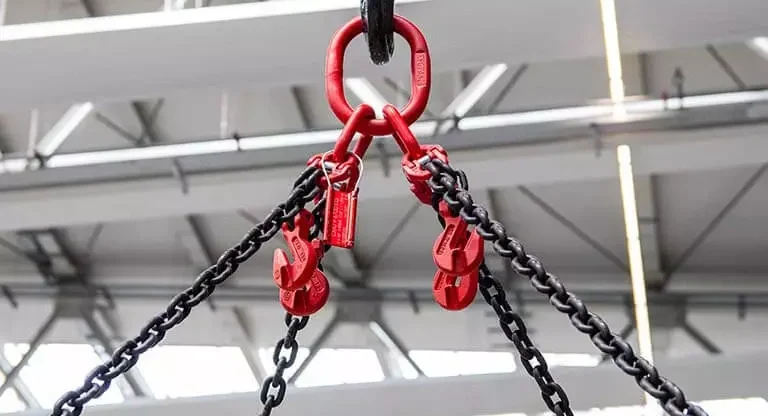
A chain sling is one of the most versatile lifting solutions available. It combines alloy lifting chains with master links, connecting links, shortening hooks, grab hooks, and safety hooks to create a complete lifting assembly.
Chain slings are popular because they offer:
- High load capacity
- Excellent durability
- Flexible configurations
- Easy inspection
- Replaceable components
- Resistance to high temperatures
They are commonly used in industries where loads have irregular shapes or where lifting points vary from one job to another.
Common Chain Sling Configurations
Choosing the correct chain sling configuration is just as important as selecting the proper chain grade.
Different lifting tasks require different sling designs to distribute loads safely and improve stability.
Single-Leg Chain Sling
The single-leg chain sling is the simplest lifting assembly.
It consists of one alloy chain connected to a master link at the top and a lifting hook at the bottom.
It is commonly used for:
- Machinery
- Pumps
- Motors
- Steel plates
- Small industrial equipment
Advantages include:
- Lightweight
- Easy handling
- Fast connection
- Cost-effective
- Suitable for vertical lifting
Double-Leg Chain Sling
A double-leg chain sling provides improved load stability by distributing weight between two lifting points.
This configuration is frequently used for:
- Steel beams
- Pipes
- Structural components
- Fabricated equipment
- Construction materials
Compared with a single-leg sling, it offers better load balance and reduces stress on individual lifting points.
Three-Leg Chain Sling
Three-leg slings are ideal for lifting objects with multiple attachment points.
They are commonly used when lifting:
- Pressure vessels
- Industrial tanks
- Machinery frames
- Heavy fabricated structures
Using three lifting legs helps improve stability while reducing the likelihood of load shifting during lifting.
Four-Leg Chain Sling
The four-leg chain sling is designed for heavy and oversized loads.
It is widely used in:
- Shipbuilding
- Wind energy projects
- Steel mills
- Offshore engineering
- Bridge construction
- Large equipment manufacturing
With four lifting legs supporting the load, stress is distributed more evenly, making it suitable for complex lifting operations.
Adjustable Chain Sling
Some lifting operations require flexibility because load sizes change frequently.
An adjustable chain sling incorporates shortening hooks or grab hooks that allow operators to modify the effective chain length without replacing the sling.
Advantages include:
- Greater versatility
- Faster rigging
- Improved load leveling
- Reduced equipment inventory
Grade 80 vs Grade 100 vs Grade 120 Lifting Chains
One of the most common questions from buyers is:
Which lifting chain grade should I choose?
The answer depends on your lifting capacity requirements, operating environment, and budget.
Among all available lifting chain grades, Grade 80, Grade 100, and Grade 120 are the most widely used for industrial lifting.
Grade 80 Lifting Chain
Grade 80 has been the industry benchmark for decades.
Manufactured from heat-treated alloy steel, it provides an excellent balance of:
- Strength
- Durability
- Safety
- Cost-effectiveness
Grade 80 lifting chains are widely used in:
- General manufacturing
- Warehousing
- Construction
- Equipment maintenance
- Logistics
- Industrial rigging
For many lifting applications, Grade 80 remains the preferred choice because it delivers dependable performance while keeping equipment costs under control.
Grade 100 Lifting Chain
Grade 100 chains provide approximately 25% greater lifting capacity than Grade 80 chains of the same diameter.
Benefits include:
- Higher Working Load Limit
- Reduced sling weight
- Improved lifting efficiency
- Better productivity
- Longer fatigue life
Because of these advantages, Grade 100 chains are increasingly used in:
- Mining
- Steel production
- Offshore engineering
- Heavy manufacturing
- Wind power installation
Although the initial investment is higher, the improved lifting capacity often reduces the total number of slings required for heavy lifting projects.
Grade 120 Lifting Chain
Grade 120 represents one of the highest-performance alloy lifting chains available today.
It offers:
- Exceptional strength
- Reduced chain weight
- Maximum lifting efficiency
- Superior fatigue resistance
Grade 120 chains are commonly selected for:
- Critical lifting operations
- Aerospace manufacturing
- Heavy industrial construction
- Specialized engineering projects
Because of their premium performance, Grade 120 chains are generally chosen where minimizing equipment weight and maximizing lifting capacity are top priorities.
Grade Comparison
| Feature | Grade 80 | Grade 100 | Grade 120 |
|---|---|---|---|
| Material | Heat-Treated Alloy Steel | Premium Alloy Steel | Ultra High-Strength Alloy Steel |
| Overhead Lifting | ✔ | ✔ | ✔ |
| Relative Strength | High | Approximately 25% Higher | Highest |
| Fatigue Resistance | Excellent | Excellent | Outstanding |
| Typical Applications | General Industry | Heavy Industry | Critical Lifting |
| Investment Cost | $$ | $$$ | $$$$ |
While all three grades are suitable for overhead lifting when properly certified, the best choice depends on the specific lifting task, operating environment, and long-term productivity goals.
How to Choose the Right Industrial Lifting Chain
Selecting an industrial lifting chain involves much more than choosing the highest strength grade. A well-informed purchasing decision should consider several technical and operational factors.
1. Determine the Working Load Limit (WLL)
Always choose a chain with a certified Working Load Limit that exceeds the maximum expected lifting load. Never rely solely on breaking strength, as safe lifting operations are based on the chain’s rated working capacity.
2. Evaluate the Working Environment
Environmental conditions have a significant impact on chain performance. Consider factors such as moisture, corrosive chemicals, abrasive dust, high temperatures, and outdoor exposure. Choosing the appropriate alloy chain and protective finish can help extend service life.
3. Match the Chain with Compatible Hardware
The lifting chain should always be paired with compatible components, including master links, connecting links, shortening hooks, and safety hooks of the same or higher grade. Mixing components with different ratings can reduce the overall lifting capacity of the assembly.
4. Consider Inspection and Maintenance
Select chains that are easy to inspect, properly marked for traceability, and supported by clear maintenance guidelines. Regular inspection helps identify wear, elongation, corrosion, or deformation before they become safety risks.
5. Work with a Reliable Manufacturer
Partnering with an experienced lifting chain manufacturer ensures consistent product quality, technical support, and compliance with international standards. A trusted supplier can also provide OEM and customized lifting solutions tailored to specific industry requirements.
Frequently Asked Questions
1. What is an industrial lifting chain?
An industrial lifting chain is a high-strength alloy steel chain specifically engineered for lifting, suspending, and handling heavy loads in industrial environments. Unlike general-purpose or transport chains, lifting chains are manufactured using premium alloy steel, heat-treated for superior strength, and proof-tested to ensure reliable performance under dynamic loading conditions. They are commonly used with overhead cranes, chain hoists, lifting slings, and other rigging equipment in industries such as construction, manufacturing, mining, shipbuilding, and logistics. Selecting a certified lifting chain with an appropriate Working Load Limit (WLL) is essential for ensuring operational safety and compliance with industry standards.
2. What is the difference between an alloy lifting chain and an ordinary steel chain?
Although alloy lifting chains and ordinary steel chains may appear similar, they are designed for completely different purposes. Alloy lifting chains are manufactured from heat-treated alloy steel that offers superior tensile strength, impact resistance, and fatigue performance. They are proof-tested, permanently marked for traceability, and certified for lifting suspended loads. Ordinary steel chains are generally intended for transportation, towing, agriculture, or utility applications and are not designed to withstand the repeated dynamic forces encountered during lifting operations. Using a non-certified chain for overhead lifting can significantly increase safety risks and equipment failure.
3. What grade lifting chain should I choose?
The appropriate chain grade depends on your lifting requirements, operating environment, and required Working Load Limit (WLL). Grade 80 lifting chains are widely used for general industrial lifting because they provide an excellent balance of strength, durability, and cost-effectiveness. Grade 100 lifting chains offer approximately 25% higher lifting capacity than Grade 80 chains of the same size, making them ideal for heavy-duty applications. Grade 120 chains are designed for the most demanding lifting environments where maximum strength and reduced equipment weight are critical. Consulting an experienced lifting chain manufacturer can help determine the most suitable option for your project.
4. What is a chain sling and when should it be used?
A chain sling is a complete lifting assembly consisting of alloy lifting chains, master links, connecting links, and lifting hooks. Chain slings are commonly used to lift heavy machinery, steel structures, pipes, fabricated components, and industrial equipment. Compared with wire rope slings or synthetic slings, chain slings provide outstanding durability, high-temperature resistance, and easy inspection. They are available in single-leg, double-leg, three-leg, and four-leg configurations to accommodate different lifting requirements and load distributions.
5. How do I choose the right industrial lifting chain?
Choosing the right industrial lifting chain begins with understanding your application. Important factors include the load weight, Working Load Limit (WLL), lifting angle, chain grade, operating temperature, environmental conditions, and compatibility with lifting hooks and rigging hardware. Buyers should also consider inspection requirements, corrosion resistance, and expected service life. Working with a professional lifting chain supplier ensures that the selected chain complies with relevant safety standards and matches the specific requirements of your lifting equipment.
6. How often should lifting chains be inspected?
Industrial lifting chains should be visually inspected before every lifting operation and periodically examined by qualified personnel according to workplace safety procedures. During inspection, operators should check for excessive wear, elongated links, cracks, corrosion, deformation, damaged welds, or other signs of deterioration. Any chain showing defects beyond the manufacturer’s allowable limits should be removed from service immediately. Regular inspection not only improves workplace safety but also extends the service life of lifting equipment and reduces unexpected downtime.
7. What industries use industrial lifting chains?
Industrial lifting chains are widely used across numerous industries where heavy materials or equipment must be safely lifted and transported. Common applications include construction, steel fabrication, manufacturing, mining, shipbuilding, offshore engineering, renewable energy, logistics, warehousing, and heavy equipment maintenance. Whether installed on overhead cranes, electric chain hoists, or custom chain sling assemblies, alloy lifting chains provide the strength, durability, and reliability required for demanding industrial operations.
8. How long does an alloy lifting chain last?
The lifespan of an alloy lifting chain depends on several factors, including lifting frequency, operating conditions, maintenance practices, and inspection intervals. Chains used in harsh environments with heavy loads or abrasive conditions may require more frequent replacement than those operating under lighter workloads. Proper storage, regular lubrication where appropriate, and routine inspections can significantly extend the service life of lifting chains. Rather than replacing chains based solely on age, they should be evaluated according to wear, elongation, corrosion, and compliance with applicable safety standards.
9. Why is Working Load Limit (WLL) important?
The Working Load Limit (WLL) is the maximum load that a lifting chain or chain sling is designed to safely support during normal operation. It is determined by the manufacturer through engineering calculations and testing, taking into account the chain grade, diameter, and required safety factor. Exceeding the rated WLL can result in permanent deformation or catastrophic failure of the lifting assembly. For safe lifting operations, users should always verify the WLL before use and ensure that all lifting components have compatible load ratings.
10. Why choose Shenli Ringing as your lifting chain manufacturer?
Shenli Ringing is a professional manufacturer specializing in industrial hooks, alloy lifting chains, chain slings, pulleys, and rigging hardware for global B2B customers. We combine advanced manufacturing technology with strict quality control to deliver lifting products that meet demanding industrial applications. Our capabilities include OEM and custom manufacturing, comprehensive product testing, fast production, and reliable international delivery. Whether you are a distributor, equipment manufacturer, or industrial contractor, Shenli Ringing is committed to providing durable lifting solutions, competitive factory pricing, and responsive technical support to help your business succeed.