
Chain for Hoist: The Ultimate Industrial Buyer’s Guide to Lifting Chain Selection, G80 vs. G100, and Safety Standards


Lifting chains are an essential tool in many industries, used to lift and move heavy loads safely and efficiently. These chains are specially designed to withstand high loads and stresses, and are made from high-strength alloy steel that is heat-treated for maximum durability. Lifting chains come in a variety of sizes, grades, and configurations to suit different applications—from overhead cranes and electric hoists to rigging and heavy towing. When used correctly and maintained properly, a high-quality chain for hoist operations can significantly improve workplace safety and operational throughput, making it an indispensable asset across manufacturing, construction, ports, and mining.
Selecting the wrong chain, however, is one of the leading causes of cataclysmic rigging failures, costly downtime, and OSHA compliance penalties. This comprehensive guide walks through the technical anatomy of hoist chains, breaks down the critical differences between G80 chain and G100 chain, outlines international compliance mandates, and provides an actionable maintenance protocol to keep your hoisting operations safe and compliant.
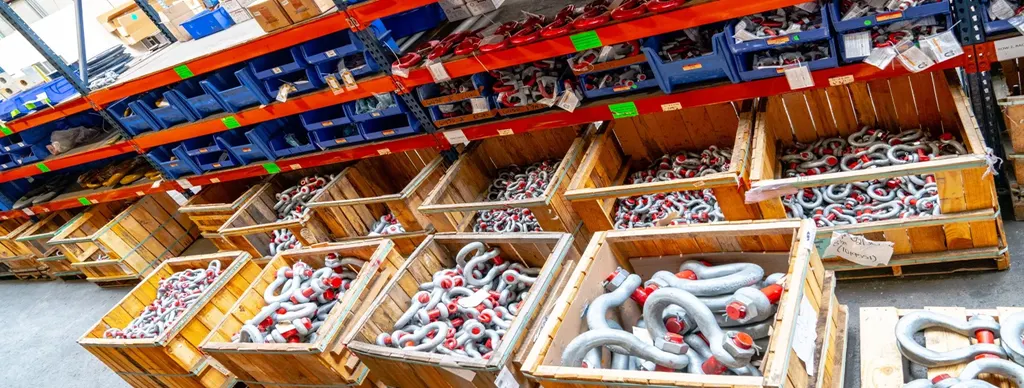
1. The Anatomy of an Overhead Hoist Chain
Not every steel chain qualifies as a load chain for hoists. General hardware chains (such as Grade 30 proof coil, Grade 43 high-test, or Grade 70 transport chain) are strictly prohibited from overhead lifting applications.
A dedicated chain for hoist systems is an engineered precision component characterized by three core manufacturing requirements:
-
Alloy Steel Metallurgy: Premium hoist chains are forged from specialized alloy steel formulations containing controlled percentages of nickel, chromium, molybdenum, and manganese. This chemistry yields high tensile strength without sacrificing ductility.
-
Controlled Heat Treatment: The chain undergoes a specialized quenching and tempering cycle. This heat treatment balances surface hardness (to resist abrasive wear as the links seat into hoist pockets and sheaves) with core toughness (to absorb dynamic shock loads without brittle fracture).
-
Calibrated Pitch and Tolerance: Manual lever pullers, electric chain hoists, and pneumatic hoists require a calibrated chain. The pitch (internal link length) and wire diameter are held to tight metric tolerances so each link articulates cleanly into the pocket wheel (load sheave) without jamming, gouging, or skipping.
2. Deciphering Chain Grades: G80 vs. G100
When sourcing a heavy-duty lifting chain, the grade designation directly indicates its tensile strength per square millimeter of cross-sectional area: Grade 80 equates to an ultimate tensile strength of $800\text{ N/mm}^2$, while Grade 100 delivers $1000\text{ N/mm}^2$.
Grade 80 (G80 Chain)
A long-standing industrial workhorse, G80 chain remains the baseline standard for overhead lifting and hoisting systems worldwide.
-
Tensile Strength: Minimum $800\text{ N/mm}^2$.
-
Design Factor: Standard 4:1 design factor for general rigging slings; hoists frequently utilize a 5:1 design factor depending on regional engineering codes (e.g., ASME B30.16).
-
Primary Environments: Foundries, steel fabrication, mining, and general manufacturing.
-
Surface Finishes: Black oxide, electro-galvanized, or painted finish.
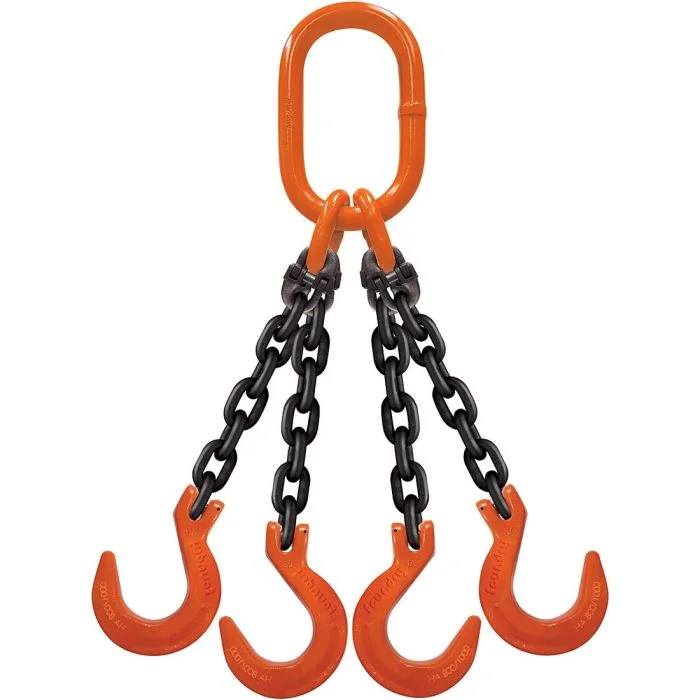
chain slings
Grade 100 (G100 Chain)
Modern industrial hoisting applications increasingly specify G100 chain. Because it is roughly 25% stronger than a G80 chain of identical link diameter, rigging crews can achieve higher Working Load Limits (WLL) while reducing overall rig weight.
-
Tensile Strength: Minimum $1000\text{ N/mm}^2$.
-
Weight-to-Capacity Advantage: A smaller, lighter chain can perform the work of a heavier G80 variant. For instance, using a 10 mm G100 chain instead of a 13 mm G80 chain significantly reduces the tare weight that rigging teams must handle overhead.
-
Surface Hardness: G100 chains feature elevated surface hardness, providing enhanced resistance against friction and premature pocket-wheel wear.
-
Primary Environments: Modular construction, wind turbine maintenance, mobile rigging, and high-duty-cycle automated crane bays.
| Specification Feature | Grade 80 (G80 Chain) | Grade 100 (G100 Chain) |
| Minimum Breaking Strength | $800\text{ N/mm}^2$ | $1000\text{ N/mm}^2$ |
| Capacity vs. Diameter | Standard base ratio | +25% capacity for the same wire gauge |
| Relative Weight | Baseline weight | ~20% lighter for identical load ratings |
| Standard Applications | Plant maintenance, standard hoists, general rigging | High-cycle hoists, mobile crane rigging, aerospace |
| Identification Stamp | Marked 8, 80, or G80 every 1 to 3 feet |
Marked 10, 100, or G100 |
| Surface Treatment | Black phosphate, zinc-plated, shot-blasted | Violet, blue, or proprietary powder coat / corrosion barrier |
3. Working Load Limit (WLL) Reference Table
Working Load Limits are based on a straight, axial pull with a standard safety factor (typically 4:1 or 5:1 depending on whether the chain functions as an internal hoist load chain or an external rigging sling).
Note: Always consult the manufacturer’s verified test certificate before putting any chain into field service.
| Nominal Diameter (mm / in) | Grade 80 WLL (kg / lbs) | Grade 100 WLL (kg / lbs) |
| 6 mm (1/4″) | 1,120 kg / 2,460 lbs | 1,400 kg / 3,080 lbs |
| 8 mm (5/16″) | 2,000 kg / 4,400 lbs | 2,500 kg / 5,500 lbs |
| 10 mm (3/8″) | 3,150 kg / 6,940 lbs | 4,000 kg / 8,800 lbs |
| 13 mm (1/2″) | 5,300 kg / 11,680 lbs | 6,700 kg / 14,770 lbs |
| 16 mm (5/8″) | 8,000 kg / 17,630 lbs | 10,000 kg / 22,040 lbs |
| 20 mm (3/4″) | 12,500 kg / 27,550 lbs | 16,000 kg / 35,270 lbs |
| 22 mm (7/8″) | 15,000 kg / 33,060 lbs | 19,000 kg / 41,880 lbs |
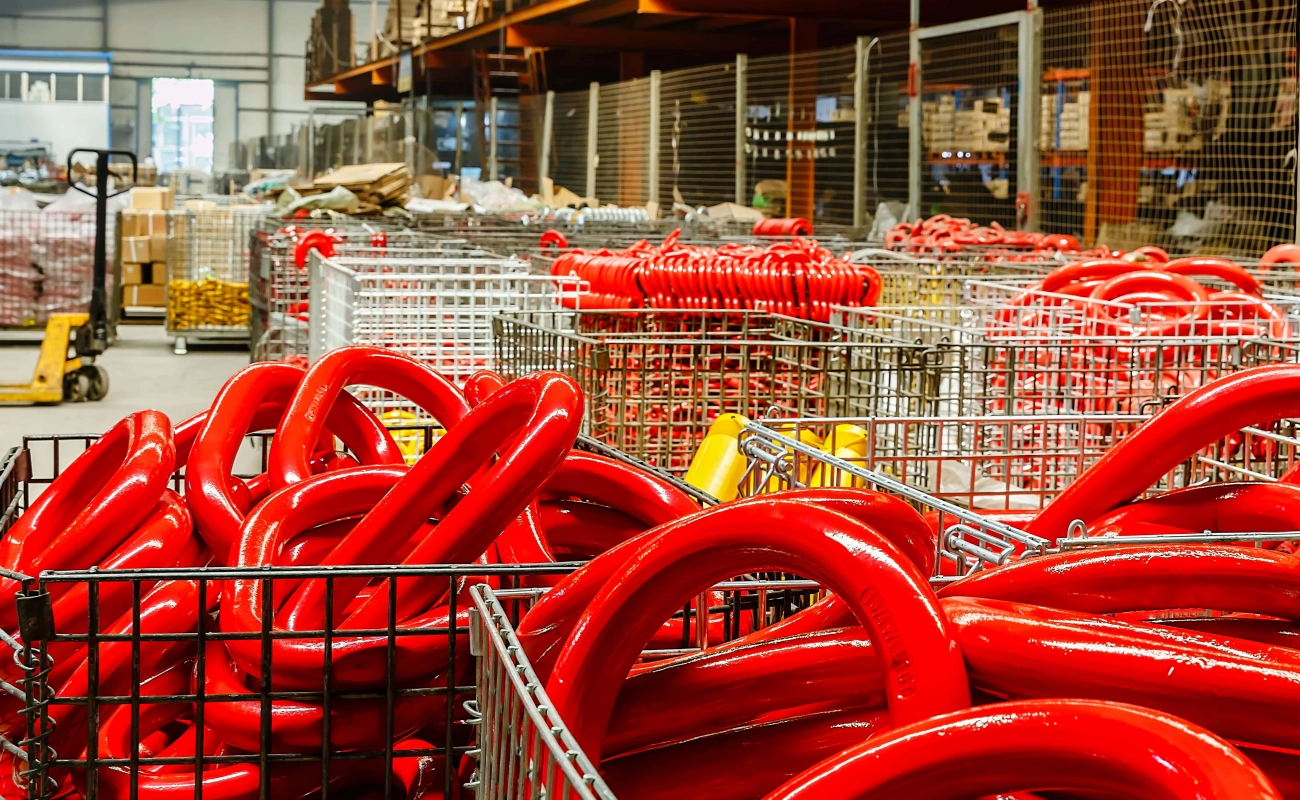
4. Key Factors When Choosing a Chain for Hoist Applications
Selecting the correct lifting chain requires an assessment that extends beyond sheer tonnage capacity. Engineering teams must evaluate:
A. Hoist Type and Pocket Wheel Compatibility
Manual hand chain hoists, lever hoists, and motorized (electric/pneumatic) hoists exert different mechanical forces on chain links:
-
Manual Chain Hoists: Lower chain speeds allow for standard heat-treated lifting chains that prioritize ductile elongation during unexpected overloads.
-
Electric Chain Hoists: Continuous, high-speed movement across the drive sprocket generates significant friction and localized heat. High-speed electric units require case-hardened load chains that resist inner-link contact wear without embrittling under cyclic loading.
B. Dynamic Loading and Service Duty Class
Static load weight calculations are insufficient. When a hoist initiates or arrests a lift, the dynamic shock factor increases the instantaneous force exerted on the chain. If your facility runs continuous cycles (e.g., FEM 3m/4m or ISO M6/M7 duty ratings), the chain must possess exceptional fatigue resistance to endure millions of load cycles without developing microscopic stress fractures.
C. Environmental Temperature Extremes
Thermal exposure permanently alters alloy steel properties:
-
G80 Performance Under Heat: Can typically operate at temperatures up to 200°C (392°F) with zero capacity reduction. Between 200°C and 300°C, a 10% reduction applies; between 300°C and 400°C, a 25% reduction applies. Use above 400°C (752°F) is strictly prohibited.
-
G100 Performance Under Heat: Because of specialized alloy tempering, G100 chains often have a maximum allowable operating temperature of 200°C (392°F) before requiring complete derating or decommissioning.
D. Corrosive and Chemical Environments
Acidic or galvanic environments (such as marine operations or pickling lines) can induce hydrogen embrittlement in high-strength steels. Standard zinc electroplating can cause microscopic hydrogen retention during the plating process; therefore, chains intended for corrosive or offshore use should feature specialized mechanical zinc-nickel coatings or manufacturer-approved protective baths.
5. Regulatory Compliance & Global Safety Standards
Legitimate hoist chains must comply with rigorous international manufacturing, proof-testing, and traceability mandates:
-
ASME B30.16 (Overhead Hoists): Governs operational standards, inspection protocols, and maintenance rules for underhung overhead hoists.
-
ASME B30.9 (Slings): Regulates the mechanical configuration and usage criteria for alloy steel chain slings.
-
EN 818-7 / EN 818-2: European standards specifying requirements for short-link chains for lifting purposes, with Part 7 focused specifically on calibrated hoist chains.
-
OSHA 1910.184: US Federal regulatory compliance mandating daily visual inspections, tagged load limits, and clear removal-from-service criteria.
Every production batch of G80 chain or G100 chain must have full traceability: each link or periodic interval will show permanent embossed markings indicating the grade and manufacturer code. Suppliers must accompany orders with a Mill Test Certificate (MTC) confirming proof-testing to at least twice the Working Load Limit.
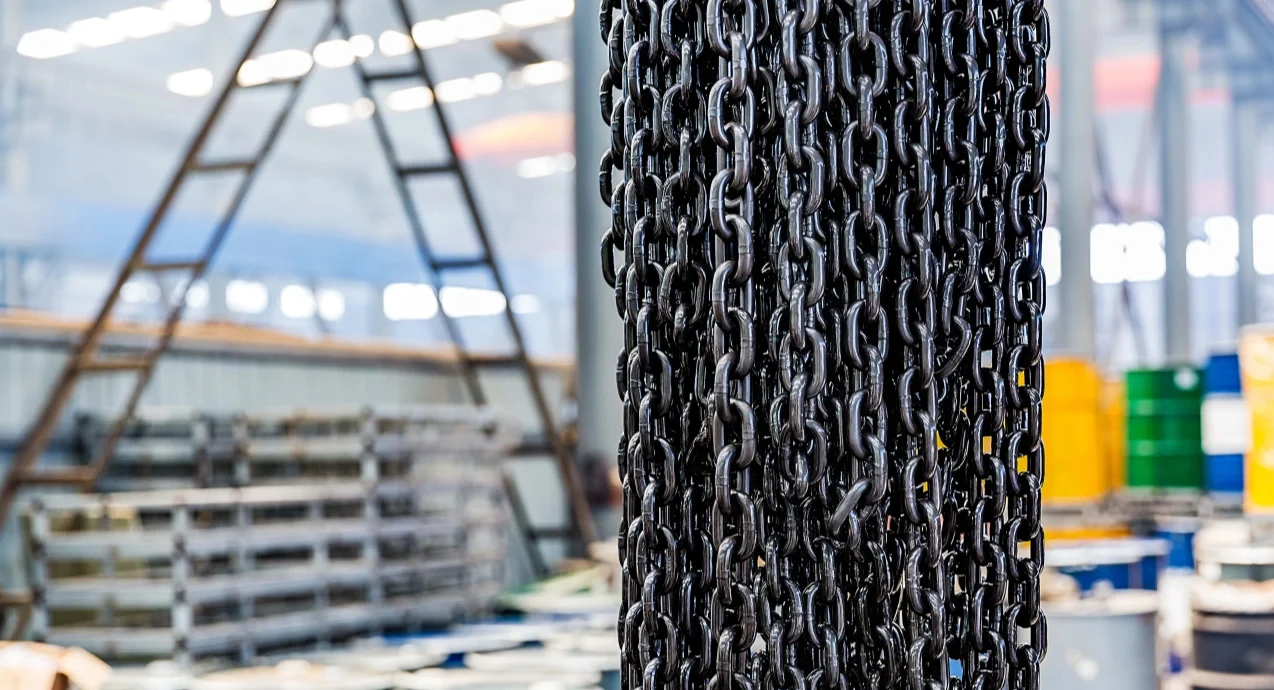
Lifting Chain
6. Proper Chain Inspection, Maintenance, and Rejection Criteria
Consistent maintenance preserves chain life and prevents mechanical failure. Rigging supervisors should mandate a three-tier inspection regimen: Initial, Frequent (Pre-Shift), and Periodic (Documented).
Rejection Criteria: When to Remove a Chain from Service
According to ASME and OSHA guidelines, immediately condemn and remove a chain for hoist operations if any of the following are observed:
-
Gauge Wear in Link Welds or Contact Points: Measure the link diameter at the interlink wear point (the crown or saddle where links articulate). If the nominal diameter has worn down by 10% or more, the chain must be discarded.
-
Pitch Elongation (Stretch): Measure a segment of 5 to 11 links using an internal vernier caliper. If link elongation exceeds 5% of the original manufactured pitch, the chain has been subjected to severe overload or localized wear and must be decommissioned immediately.
-
Mechanical Bending, Twisting, or Gouging: Any link that displays physical bending, torsional twisting, notches, or welding splatter must be cut out of service.
-
Thermal Discoloration: Dark discoloration, blue tinting, or evidence of electric arc strikes indicates that the metal’s heat-treatment microstructure has been altered, compromising its mechanical strength.
-
Excessive Corrosion or Pitting: Heavy rust that prevents fluid link articulation or produces visible pit marks in the alloy matrix requires removal.
Hoist Chain Lubrication Best Practices
Never run an electric or manual hoist chain completely dry. Friction between articulating links under load generates significant abrasive wear and heat:
-
Clean the chain periodically using mineral spirits or mild degreasers—never use acid-based cleaners.
-
Apply a non-acidic, penetrating lubricant formulated for wire ropes and hoist chains (such as an EP lubricating oil). The oil must seep into the bearing contact points between interlocking links.
-
Wipe off excess exterior lubricant in dusty or abrasive environments (e.g., cement plants, sawmills) to prevent the chain from acting as a magnet for grit that will grind down the pocket sheaves.

7. Maximizing Rigging Safety and ROI
Investing in a high-grade chain for hoist operations directly impacts workplace safety and operational throughput. While a high-grade G100 chain carries a higher initial procurement cost than standard G80 chain, its superior strength-to-weight ratio, lighter physical profile, and extended wear life often deliver a lower Total Cost of Ownership (TCO) in rigorous multi-shift environments.
Ensure that all lifting gear is sourced through accredited manufacturers, verified by traceable test certificates, matched precisely to hoist pocket specifications, and maintained under rigorous inspection protocols.