
Winch Hook Procurement & Engineering Guide: Specifications, Quality Control, and Supply Chain Risk Management


A heavy-duty winch hook is often treated as an off-the-shelf commodity, yet it serves as the single critical point of failure in any recovery, pulling, or load-positioning system. Whether sourcing hardware for commercial vehicle fleets, OEM utility trailers, maritime slipways, or aftermarket off-road programs, selecting the wrong rigging attachment leads to catastrophic kinetic dropouts, field liability claims, and costly brand damage.
Securing a robust, high-integrity winch hook requires far more than matching rated tonnage to an estimated vehicle weight. Professional buyers must navigate metallurgy, fracture mechanics, grain structures formed through closed-die forging, surface passivations, and the ongoing market shift between traditional hooks and closed-system rigging. This technical procurement manual dissects every commercial factor—from raw steel batch tracing to purchase order (PO) spec writing—equipping global sourcing engineers and hardware category managers to secure zero-defect recovery components.
1. Winch Hook Anatomy, Metallurgy, and Core Design Typologies
A winch hook transforms line tension generated by a winch drum into a controlled pulling vector applied to an anchor point. Its geometry must distribute severe bending stresses across a varying cross-sectional radius while preserving throat clearance and securing the connection interface against accidental slippage.
Critical Anatomical Zones
-
The Eyelet / Pin Hole: The termination junction securing the hook to the recovery line. In traditional designs, a circular eye accepts a cable thimble; in modern utility hardware, a clevis interface houses a machined load pin secured by a cotter pin or circlip. This region sustains severe combined shear, bearing stress, and cyclic hoop tension.
-
The Saddle (Neck): The structural curve that transitions line pull into the main hook body. Inadequate transitional fillet radii here create acute stress concentrations that trigger fatigue micro-fissures under pulsing kinetic loads.
-
The Bowl (Bight): The load-bearing interior radius where the sling, strap, or shackle pin nests. A wide, smooth bowl geometry reduces localized contact pressure (Hertzian stress) on mating hardware and prevents the severe pinching that degrades synthetic fiber slings.
-
The Throat Opening: The clear distance between the tip and the saddle. It must be wide enough to admit standard rigging points without forced canting, yet narrow enough to preserve throat rigidity against lateral deflection under load.
-
The Safety Latch Assembly: The retention mechanism spanning the throat opening. Modern commercial standards dictate heavy-gauge, stamped or cast spring-loaded latches designed to prevent accidental unseating of lines when tension is slackened.
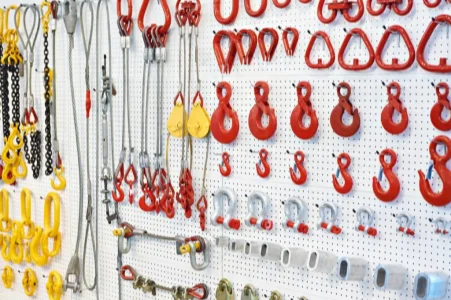
Exploring-the-World-of-Rigging-Equipment
Metallurgical Foundations: Carbon Steel vs. Alloy Steel Grades
A cast iron or low-carbon steel hook represents extreme operational hazard in dynamic recovery environments. Commercial lifting and rigging components demand heat-treated medium-carbon or low-carbon alloy steels.
-
Carbon Steel (e.g., AISI 1045 / ASTM A521 Class C): Typically used for light utility, agriculture, or entry-level commercial winches. While economical and ductile when normalized, it requires substantial physical mass to achieve acceptable working load limits (WLL). It exhibits lower yield thresholds and lower toughness at sub-zero temperatures.
-
High-Strength Alloy Steel (e.g., 35CrMo, 40Cr, AISI 4140, AISI 4340): Standard for industrial-grade Grade 80 and Grade 100 rigging forgings. The inclusion of chromium, molybdenum, and nickel promotes deep through-hardening during heat treatment. These alloys yield tensile strengths exceeding 800 to 1000 MPa, allowing for compact hook profiles that retain high fracture toughness (Charpy V-notch values > 42 Joules at -20°C).
-
Marine-Grade Stainless Steel (e.g., Cast/Forged 316 / 316L): Specified when continuous exposure to marine spray, saline environments, and chemical washdowns is non-negotiable. Stainless steel offers exceptional corrosion resistance via its passive chromium-oxide surface film. However, its raw tensile and yield ratings sit lower than quenched-and-tempered Grade 80 structural alloy steel, requiring heavier cross-sections for equivalent ratings.
Hook Architectures: Clevis, Eye, and Self-Locking
Choosing the right structural configuration affects installation labor, field servicing, and long-term operating safety:
-
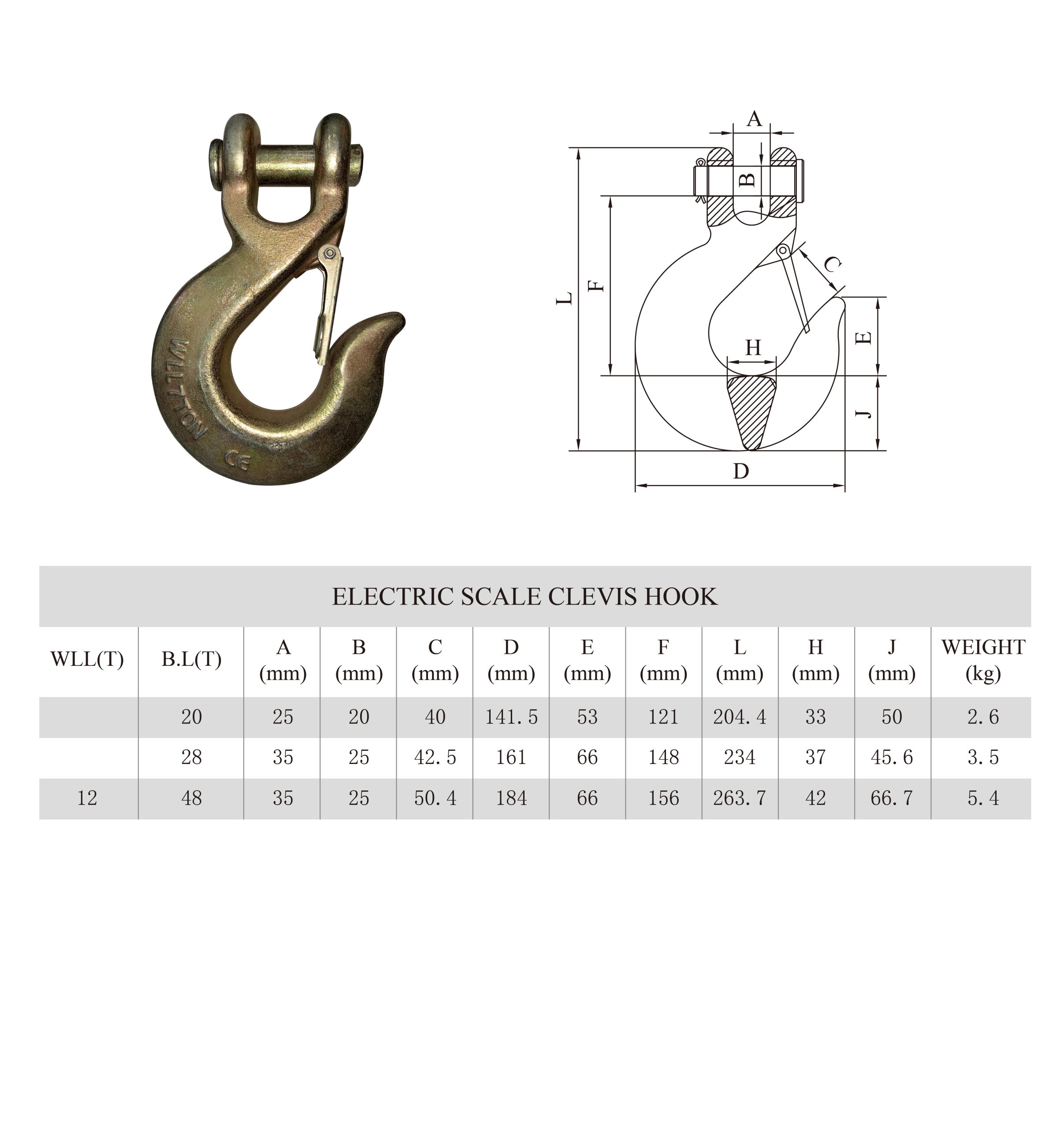
Clevis Winch Hooks: The clevis hook integrates a bifurcated base holding a precision-machined alloy load pin retained by a cotter key. It connects directly to the thimble eye of a winch cable hook assembly or synthetic line without an intermediate joining link. It simplifies line replacements in the field, making it the dominant OEM format for vehicle recovery winches.
-
Eye Winch Hooks: Features an integral, unbroken forged loop at the hook shank. An eye hook requires an external mechanical joining element—such as a Grade 80 hammerlock (connecting link) or a screw-pin shackle—to mate with looped cable ends. While less streamlined for standard vehicle fairleads, eye hooks eliminate the single-shear pin failure mode of a clevis pin and allow greater articulation along multiple axes.
-
Self-Locking Hooks: Highly favored in industrial hoisting and severe utility winching. When tension loads the hook bowl, the integrated latch mechanism rotates closed and automatically interlocks into a recessed cavity on the hook tip. The latch cannot open under line tension, eliminating dropouts caused by dynamic slack cycles. Self-locking hooks command a higher unit cost and add mass to the rope terminus, but maximize fail-safe operation.
2. Dynamic Performance: Winch Cable Hook vs. Synthetic Winch Hook Systems
A recovery line is only as reliable as the terminal attachment designed to hold it. Wire rope and ultra-high-molecular-weight polyethylene (UHMWPE) synthetic lines place fundamentally different mechanical and environmental demands on terminal hardware.
Wire Rope Rigging Mechanics
Galvanized or bright carbon steel aircraft-grade wire rope (typically 7×19 or 6×36 IWRC configurations) operates under high hoop stiffness and substantial elastic energy storage. When outfitted with a traditional hook for winch cable applications, the mating surface between the wire rope’s teardrop steel thimble and the hook’s clevis pin concentrates tremendous shearing forces across a small surface contact area.
Steel cables can tolerate tight bend radii, sharp edges, and minor burrs on the hook bowl without immediate structural failure. However, wire ropes are prone to kinking, wire fraying, and destructive dynamic recoil (“cable whip”) if terminal hardware fractures under tension. Hardware paired with wire rope must emphasize heavy-duty clevis pin retention, deep throat clearances, and spring latches capable of retaining stiff cable that springs loose when line tension momentarily relaxes.
Modern UHMWPE Synthetic Line Dynamics
Synthetic winch lines manufactured from HMPE/UHMWPE fibers (e.g., Dyneema® SK75/SK78) have transformed recovery operations by cutting line mass by roughly 80% and mitigating projectile kinetic recoil during line breaks. Yet, synthetic ropes are highly susceptible to cutting, fiber fusion, and frictional shear failure at the terminal interface.
A synthetic winch hook must feature:
-
Generous Internal Radii: A sharp edge or narrow saddle profile pinches synthetic strands, driving down the rope’s breaking strength via the “D/d ratio” effect (ratio of curvature diameter to rope diameter).
-
Ultra-Smooth Surface Micro-Finishes: While a standard forged steel hook with an as-forged or rough powder-coated bowl suffices for a steel thimble, synthetic lines demand surface roughness values below Ra 0.8 µm on all load-bearing and transition surfaces to prevent inter-strand fiber abrasion.
-
Burr-Free Clevis Pockets: When a synthetic eye connects directly over a clevis pin without a tubular reinforcement thimble, any machining chatter or unchamfered edge inside the clevis fork can slice through load-bearing fibers within dozen dynamic cycles.
Transition Hardware: Synthetic Winch Accessories
Modern commercial fleets routinely upgrade wire systems to synthetic rope packages, requiring matching synthetic winch accessories. These include:
-
Gusseted Tubular Thimbles: Heavy-wall steel or hard-anodized aluminum thimbles pressed inside the rope’s spliced eye to keep it from collapsing under peak line tension.
-
Winch Line Savers and Isolators: Polyurethane bumpers that absorb impact when winding the hook fully against the fairlead, preventing structural shock loading on the winch drum and gear train.
To protect rigging integrity during frequent reel-in cycles, buyers frequently source a specialized winch dampener and cable safety equipment to prevent terminal kinetic shocks and extend rope service life.
3. Manufacturing Processes: Forged vs. Cast Hardware Failure Modes
Rigging failures happen fast. Sourcing engineers must understand how manufacturing processes influence failure modes: gradual plastic deformation (safe) versus sudden brittle fracture (catastrophic).
Closed-Die Drop Forging
In drop forging, a pre-heated steel billet (typically 1150°C to 1250°C) is placed between precision-machined dies and struck by heavy mechanical or hydraulic rams. This massive mechanical deformation realigns the internal crystal matrix into a continuous, directional grain flow that tracks the contours of the hook profile.
-
Grain Alignment: Structural grain lines run uninterrupted from the mounting eye, along the outer spine, through the high-moment bowl, and out through the tip. This continuous alignment delivers maximum resistance to dynamic impact, fatigue cycles, and tensile stress.
-
Defect Elimination: The intense compressive pressure eliminates internal micro-porosity, consolidates gas pockets, and yields uniform material density across heavy and thin cross-sections alike.
-
Failure Mode: Under extreme overload, a properly forged, quenched-and-tempered alloy hook yields and opens at the throat gradually. This visible plastic deformation alerts operators to back off before catastrophic line detachment occurs.
Casting: The Silent Procurement Trap
Casting introduces molten metal into sand, shell, or investment ceramic molds. While it allows for intricate geometries and minimizes tooling costs for small-batch runs, it introduces severe structural liabilities in dynamic recovery equipment:
-
Micro-Porosity and Inclusions: Entrapped gases, shrinkage voids, and slag inclusions naturally collect in thicker cross-sections like the hook bowl. These internal voids act as sharp notch concentrators.
-
Brittle Dendritic Structures: Cast steel cools with a non-directional, dendritic grain structure. Lacking continuous mechanical grain alignment, it exhibits substantially lower impact toughness at low temperatures.
-
Failure Mode: When subjected to dynamic shock loads (e.g., snatching a mired vehicle), cast steel can snap abruptly at normal working capacities without prior necking or visible throat elongation.
Heat Treatment: Quenching and Tempering
Forging alone does not guarantee structural integrity. Components must undergo a continuous, computer-monitored heat treatment:
-
Austenitizing: Heating the forged hooks above their critical temperature (typically 850°C–880°C for 4140/35CrMo alloys) to create a homogenous austenitic crystal phase.
-
Quenching: Rapidly cooling the steel in agitated polymer, oil, or water baths to transform the microstructure into hard, brittle martensite.
-
Tempering: Reheating the parts to a precise intermediate temperature (550°C–650°C) and soaking them for hours. This tempers the martensitic structure, converting it into fine, tough sorbite or tempered martensite. This balances hardness (typically 28 to 34 HRC) with high yield strength and severe-impact ductility.
4. Technical Comparison: Hook vs. Shackle Rigging Architectures
The commercial recovery sector is shifting toward closed-system winching (CSW), prompting buyers to evaluate the operational tradeoffs between open hook and shackle connections.
Direct Engineering Comparison
| Engineering Parameter | Conventional Clevis Winch Hook | Screw Pin Bow Shackle (Anchor Shackle) | Closed-System Winch Thimble / ProLink |
| Connection Topology | Semi-open throat secured by spring latch | 100% closed loop retained by threaded pin | Fully captive, internal pin-to-shackle mount |
| Accidental Detachment Risk | Moderate; latch can fail or bend under side load | Very low; requires manual rotation of the pin | Negligible; dynamic recovery line cannot slip |
| Multi-Planar Loading Limit | Highly restricted; off-axis pull deforms the bight | Capable of 45° to 90° off-axis pull (with de-rating) | Confined to inline shackle axis |
| Deployment Speed | Extremely fast (single snap onto recovery eye) | Slower; requires threading and unscrewing pin | Moderate; requires connecting independent shackle |
| Rigging Envelope / Profile | Large, asymmetrical; prone to snagging rocks | Compact, balanced footprint | Ultra-compact; nests flush into fairlead throat |
| Failure Warning Indicators | Visible throat opening deformation | Pin binding, localized thread stripping | Visual stress inspection on pin bore hole |
While open hooks deliver fast connection speeds for towing and utility crews, closed-system rigging with a dedicated winch shackle or captive recovery mount eliminates accidental line rollout. This is especially valuable when winching across rough terrain where tension fluctuates dynamically. To design balanced, multi-point recovery kits, buyers should review our dedicated technical guide on winch shackle vs bow shackle load capacities.
5. Industrial Rigging Formats: Straps, Marine Systems, and Towing Assemblies
Commercial winching reaches far beyond standard vehicle recovery. Specialized markets demand custom configurations tuned to unique dynamic, environmental, and spatial constraints.
Integrated Strap Systems
Flat-braided polyester and nylon recovery straps require specialized hook designs. A conventional narrow-bowed hook pinches flat webbing, bunching synthetic strands and causing localized shear failure across the edge fibers.
-
The Winch Strap Hook: Engineered with a broad, flat, machined base slot (typically 2-inch to 4-inch wide) that supports webbing across its full lateral surface. This geometry maintains an even load across all structural warp threads.
-
The Winch Hook Pull Strap: A simple, high-visibility nylon strap loop attached to the hook eye or body. It gives riggers a safe, non-slip handhold when handling tensioned hooks, keeping hands clear of the winch fairlead and pinch points.
Marine and Boat Trailer Systems
Marine environments expose recovery hardware to aggressive electrochemical corrosion. A boat winch strap with safety hook configuration must withstand cycles of saltwater submersion, drying, and intense solar UV exposure.
-
Material Selection: Top-tier marine hardware uses forged AISI 316 stainless steel or heavy hot-dip galvanized Grade 50 carbon steel. Electro-galvanized finishes degrade rapidly in ocean environments.
-
Latch Durability: Torsion springs within the safety latch must use passivated marine-grade stainless spring wire (AISI 302/316). Entry-level carbon steel latch springs quickly rust and fail, leaving the hook throat unguarded.
-
Webbing Interface: Marine trailer straps are typically flat-woven, high-tenacity polyester. Hook eyes must be chamfered to prevent edge burrs from wearing down the webbing loop during vessel launch and recovery.
Commercial Recovery and Wrecker Fleets
Industrial towing and flatbed wreckers operate under high cyclic duty, pulling rolled or locked-wheel commercial vehicles up severe inclines.
-
Systems usually specify a Grade 70 transport hook or Grade 80 alloy clevis hook directly swaged to a 3/8-inch or 7/16-inch high-tensile wire rope.
-
The safety latch must resist repeated impacts against pavement, gravel, and steel flatbed decks. Heavy forged latches with recessed spring pockets offer far longer service lives than thin stamped-steel latches.

6. Manufacturing Case Study: Root Cause Failure Analysis in Low-Temperature Operations
The following failure investigation from our engineering testing facility illustrates the catastrophic risk of cutting corners on alloy chemistry and heat treatment regimes.
Incident Background and Failure Mechanics
A municipal utility contractor operating in Edmonton, Canada, experienced a catastrophic hook fracture during a sub-zero recovery operation. Ambient temperature sat at -28°C (-18.4°F). A utility service truck had slid off an icy service access road and was being recovered via a truck-mounted hydraulic winch running a 3/8-inch synthetic line.
As the line tension reached an estimated 6,800 lbs (30.2 kN)—well below the hook’s stated 12,000-lb (53.4 kN) Working Load Limit—the clevis hook shattered across the main curvature of the bowl. The sudden detachment projected the synthetic rope assembly toward the winch fairlead. Fortunately, the line dampener arrested the hardware, preventing operator injury. The fractured components were quarantined and sent to our laboratory for metallurgical root-cause failure analysis (RCFA).
Forensic Laboratory Findings
-
Visual and Macroscopic Examination: The fracture surface presented a flat, highly reflective, crystalline appearance without necking or cross-sectional thinning. Chevron markings pointed directly to an initiation site along the outer tension perimeter of the hook bight. The absence of shear lips confirmed an instantaneous, brittle transgranular cleavage fracture.
-
Spectrographic Chemical Analysis: Optical Emission Spectroscopy (OES) revealed the alloy composition deviated significantly from standard Grade 80 alloy specifications:
-
Carbon (C): 0.48% (Exceedingly high for high-impact alloy, promoting brittle structures)
-
Manganese (Mn): 0.65%
-
Chromium (Cr): 0.15% (Severe trace deficit vs. 4140 spec of 0.80–1.10%)
-
Molybdenum (Mo): 0.02% (Near total omission vs. 4140 spec of 0.15–0.25%)
-
Phosphorus (P) & Sulfur (S): 0.042% and 0.038% (High impurity concentrations)
-
Conclusion: The supplier used cheap, unrefined scrap carbon steel instead of the specified AISI 4140 alloy, relying on high carbon content to simulate tensile strength while gutting fracture toughness.
-
-
Hardness and Microstructural Analysis: Metallographic polishing and 2% Nital etching revealed a coarse, untempered martensitic and pearlite grain structure. Micro-hardness surveys showed significant variation, ranging from 44 HRC near the surface to 24 HRC at the core, indicating improper, inconsistent quenching and an skipped tempering cycle.
-
Charpy V-Notch (CVN) Impact Testing: Secondary samples cut from the intact hook shank were subjected to CVN testing per ASTM E23 at -20°C. The specimens delivered an average impact energy of just 8.2 Joules (6.0 ft-lbs). By contrast, properly quenched and tempered AISI 4140 alloy steel guarantees impact toughness exceeding 45 Joules at identical temperatures.
Remediation and Supply Chain Takeaways
This failure exposed three fatal sourcing lapses:
-
Relying on generic raw mill test certificates provided by an unvetted Tier-2 forging house without third-party laboratory verification.
-
Omitting sub-zero Charpy V-notch toughness specifications from the original RFQ documents.
-
Failing to audit the supplier’s automated continuous heat-treatment logs.
The municipal contractor updated their procurement standards immediately: all future winch hardware must require 3.1 Material Test Reports, batch-specific chemical verification, CVN validation at -20°C, and closed-die forged construction.
7. Quality Assurance, Testing Protocols, and International Standards
Commercial procurement mandates rigorous compliance with international test frameworks to prevent field failures and defend against product liability claims.
Authoritative Regulatory and Rigging Frameworks
Commercial testing regimens are governed by established international standards:
-
American Society for Testing and Materials: Tensile, yield, and elongation parameters are defined according to ASTM A370, which specifies standard mechanical testing methods for steel products. Sub-zero toughness criteria must be verified using the Charpy impact guidelines defined in ASTM E23.
-
International Organization for Standardization: Forging criteria, safety factors, and dynamic testing requirements should reference ISO 7597, which governs forged steel lifting hooks with point and eye for Grade 8 components.
-
Industry Engineering Guidance: Hook design, loading criteria, and inspection intervals should conform to recommendations from the American Society of Mechanical Engineers, particularly the safety frameworks in ASME B30.10: Hooks.
NDT: Magnetic Particle and Liquid Penetrant Testing
Sub-surface fissures and surface-breaking stress cracks are invisible to the naked eye. Robust factory quality plans include Non-Destructive Testing (NDT):
-
Magnetic Particle Inspection (MPI): The gold standard for ferromagnetic forged hooks. The hook is magnetized while fluorescent iron particles suspended in liquid bathe its surfaces. Under ultraviolet (UV) light, magnetic flux leakage instantly reveals forging laps, quenching cracks, and seams. High-reliability POs specify wet-fluorescent MPI per ASTM E1444 on a 100% basis or a verified AQL Level II sampling plan.
-
Liquid Penetrant Inspection (LPI): Used for non-ferrous, marine-grade austenitic stainless steel hooks (e.g., AISI 316). Fluorescent dye penetrates surface fissures, is wiped clean, and is drawn out with a dusting developer agent to highlight micro-flaws.
[Factory Field Experience I: Wet Magnetic Particle Inspection Defect Traps]
During a 15,000-unit production run of 3/8-inch clevis recovery hooks at our manufacturing
facility, our QA station observed a sudden spike in reject rates during post-quench wet
fluorescent MPI. Roughly 4.2% of parts exhibited recurring longitudinal surface crack
indications along the inner radius of the clevis fork.

Tooling and metallographic analysis traced the root cause to tool wear on the clevis-slot
milling broach. Rather than cleanly cutting the annealed steel, the worn broach had torn
the micro-surface, creating micro-notches less than 0.05 mm deep. When the hooks hit the
polymer quench, thermal shock concentrated at these tears and triggered localized martensitic
quench cracks.

We immediately revised our internal Standard Operating Procedure: broach cutting tools
must be inspected and re-sharpened after every 1,200 cycles, and we added a 0.5 mm corner
chamfer pass prior to heat treatment. The failure rate dropped immediately back to zero.
Destructive Testing: Proof Load, Ultimate Break, and Cyclic Fatigue
Non-destructive checks confirm structural uniformity; destructive tests confirm real-world performance limits.
-
Proof Load Testing: Every production batch must undergo a proof load test—typically 2.0 to 2.5 times the rated Working Load Limit (WLL). The machine applies the tension for a 10 to 30 second dwell period. Post-test dimensional checks must show zero measurable permanent deformation across the throat opening.
-
Ultimate Tensile Break Testing: Sacrificial samples from each master heat batch are pulled to destruction on calibrated tensile test beds. The assembly must achieve its design safety factor—typically 4:1 or 5:1 for commercial vehicle recovery, and up to 6:1 for overhead-rated lifting formats—before failing.
-
Cyclic Fatigue Testing: Hooks undergo high-cycle fatigue evaluation, oscillating between 0.5x and 1.5x WLL at 2 to 4 Hz for a minimum of 20,000 continuous cycles. This checks for micro-fissure initiation along the outer spine and the clevis pin journal.
Surface Finishing and Environmental Corrosion Testing
Hooks mounted to vehicle bumpers, commercial trailers, and marine slipways operate in harsh environments. Standard finishes include:
-
High-Gloss Powder Coating: Tough and impact-resistant, but road debris can chip the coating, letting road salt creep underneath and corrode the substrate unseen.
-
Cataphoretic Electro-Coating (KTL/E-Coat): Immersion-based organic coating that covers every internal recess, bore hole, and thread with uniform micron-level thickness. It serves as an ideal anti-corrosion primer under powder coats.
-
Electro-Galvanizing and Zinc-Nickel Plating: Often selected for load pins and safety latches. High-spec Zinc-Nickel (ZnNi 12-15%) coatings can withstand over 1,000 hours of neutral salt spray exposure per ASTM B117 before showing red rust, far outperforming standard clear zinc finishes.
[Factory Field Experience II: Salt Spray Failures on Plated Clevis Load Pins]
We once audited a series of field warranty returns involving seized clevis pins on
zinc-plated recovery hooks operating in coastal municipalities. The pins were binding
inside the hook clevis ears within six months of deployment.

Testing the OEM-supplied load pins per ASTM B117 salt spray standards, red rust appeared
after just 96 hours. The vendor had applied cheap hexavalent-free bright zinc electroplating
(5 to 8 microns thick) and skipped hydrogen embrittlement baking, leaving the hardened
40Cr pins susceptible to stress-corrosion cracking.

We solved this across all subsequent production runs by adopting a 12-micron Zinc-Nickel
(ZnNi) electroplating process followed by a trivalent chromate seal and an immediate
4-hour de-embrittlement bake at 200°C. In subsequent ASTM B117 qualification runs, the pins
surpassed 1,200 hours of continuous exposure with zero white or red corrosion products,
completely eliminating seized pin field claims.
8. Procurement Checklists, Technical Specifications, and RFQ Optimization
Vague purchase orders breed field failures. Sourcing teams must translate application requirements into explicit, measurable parameters to ensure clean, consistent vendor deliveries.
Engineering Parameters: Working Load Limit (WLL) vs. Minimum Breaking Strength (MBS)
-
Working Load Limit (WLL): The absolute maximum static load the manufacturer permits the hardware to support during regular service. It incorporates an engineered safety factor.
-
Minimum Breaking Strength (MBS): The minimum tensile force at which the component is guaranteed to yield and tear apart during destructive testing.
-
Design Safety Factor: The numerical ratio of MBS to WLL:
$$\text{Design Factor} = \frac{\text{MBS}}{\text{WLL}}$$In commercial winch recovery, this ratio typically runs between 3.5:1 and 5:1. Commercial hoisting applications enforce a mandatory 5:1 or 6:1 ratio.
Factory Audit Verification Checklist for B2B Sourcing Teams
Before issuing a tooling purchase order to any prospective hardware manufacturing facility, complete this on-site factory verification checklist:
-
[ ] Forging Plant Capabilities: Does the facility operate closed-die power drop-hammers or automated screw presses, or are they sub-contracting forging billets out to third-party hammer shops?
-
[ ] Tooling & Die Life Tracking: What is the replacement interval for forging impressions? (Worn dies yield oversized flash lines, off-center clevis profiles, and structural cross-section variance).
-
[ ] Heat-Treatment Traceability: Does the heat-treatment shop use continuous mesh-belt furnaces with automated zone temperature data-logging, or manual, operator-dependent batch salt-bath pits?
-
[ ] Quenching Medium Controls: Are polymer/oil quenching temperatures, agitation rates, and fluid cleanlines monitored with documented SPC charts?
-
[ ] In-House Testing Infrastructure: Does the plant have a calibrated tensile bed (minimum 500 kN capacity), a CVN impact pendulum, optical emission spectrometers, and certified MPI stations?
-
[ ] Traceability Markings: Can the supplier roll-forge or stamp clean, permanent lot tracking codes, steel grades, and WLL ratings directly into the component’s spine?
-
[ ] Latch Durability Setup: Are safety latches stamped from heavy spring steel (thickness ≥ 1.8 mm) with stainless steel torsion springs and non-loosening locknuts on retention hardware?
Step-by-Step Guide: How to Write an Airtight PO Specification Sheet
To prevent supply chain quality fade and reject non-compliant deliveries, use this step-by-step drafting framework:
STEP 1: Define Material Grade, Alloy Chemistry, and Production Method
  └── Action: Specify closed-die forged AISI 4140, 4340, or 35CrMo alloy steel per ASTM A521.
  └── Rule: Explicitly prohibit casting, welding, or unvetted scrap carbon steel.

STEP 2: Lock Down Target Mechanical Properties and Heat Treatment
  └── Action: Specify Quenched and Tempered condition to 28-34 HRC.
  └── Rule: Mandatory Charpy V-notch: Average >= 42 Joules at -20°C per ASTM E23.

STEP 3: Establish Precise Loading Metrics and Safety Factors
  └── Action: State required WLL (e.g., 12,000 lbs) and minimum Design Factor (e.g., 4:1).
  └── Rule: Specify that 100% of lots must pass 2.0x WLL proof load without permanent set.

STEP 4: Set NDT Criteria and Accept/Reject Thresholds
  └── Action: Specify wet fluorescent MPI per ASTM E1444 on an AQL Level II sampling plan.
  └── Rule: Zero allowable linear indications or cracks along saddle, neck, or clevis roots.

STEP 5: Define Surface Passivation, Color, and Plating Specs
  └── Action: Detail pre-treatment (zinc-phosphate or E-coat) + powder coat thickness (80-120 um).
  └── Rule: Demand >= 720 hrs neutral salt spray resistance per ASTM B117 without red rust.

STEP 6: Prescribe Traceability, Certification, and Shipping Packaging
  └── Action: Mandate raised or recessed forged markings: Brand Logo, WLL, Grade, Lot Code.
  └── Rule: Every shipment must include an EN 10204 Type 3.1 Inspection Certificate.
Complete Specification Sheet Template
Incorporate this matrix directly into your Request for Quotation (RFQ) packages and manufacturing supply agreements:
ENGINEERING PROCUREMENT SPECIFICATION: HEAVY-DUTY CLEVIS WINCH HOOK
SPECIFICATION CODE: WH-G80-HEAVY-REV3
1.0 MATERIAL & MANUFACTURING
    1.1 Manufacturing Process: Closed-Die Drop Forged. Casting strictly banned.
    1.2 Alloy Chemistry: AISI 4140 / 35CrMo compliant with ASTM A29.
    1.3 Grain Structure: Continuous, uninterrupted longitudinal grain alignment.
    1.4 Grain Size: ASTM No. 5 or finer per ASTM E112.

2.0 MECHANICAL REQUIREMENTS
    2.1 Working Load Limit (WLL): 12,500 lbs (55.6 kN).
    2.2 Minimum Breaking Strength (MBS): 50,000 lbs (222.4 kN).
    2.3 Design Factor: 4:1 minimum safety margin.
    2.4 Hardness Range: 28 to 34 HRC across the core cross-section.
    2.5 Sub-Zero Impact Toughness: >= 42 Joules at -20°C (Charpy V-Notch, ASTM E23).

3.0 HEAT TREATMENT & SURFACE PREPARATION
    3.1 Heat Treatment: Continuous Quench & Temper (Austenitized at 860°C, Tempered at 600°C).
    3.2 Surface Roughness: Hook bowl and saddle internal radius Ra <= 1.6 um (Ra <= 0.8 um for synthetic rope models).
    3.3 Surface Finishing: Zinc-phosphate primer + thermoset electrostatic polyester powder coat (80-120 um dry film thickness).
    3.4 Hardware Plating: Clevis pin and latch hardware plated with Zinc-Nickel (ZnNi >= 12%) per ASTM B841; min 1000 hrs ASTM B117 salt spray resistance.

4.0 QUALITY ASSURANCE & LOT INSPECTION
    4.1 Non-Destructive Testing: 100% Wet Fluorescent Magnetic Particle Inspection per ASTM E1444. Zero cracks allowed.
    4.2 Proof Load Validation: 2.0x WLL applied for 15-second hold. Zero permanent throat elongation (tolerance <= 0.2 mm).
    4.3 Destruction Frequency: 1 unit per 1,000 pcs or 1 per heat treatment batch pulled to failure.
    4.4 Documentation: EN 10204 Type 3.1 Material Test Certificate delivered with every production lot.

5.0 MARKING & TRACEABILITY
    5.1 Forged Identification: Hook body must feature legible forged markings: [BUYER LOGO] [WLL RATING] [GRADE 80] [HEAT LOT CODE].
    5.2 Clevis Pin: Stamped with corresponding heat batch number.
When building out field hardware catalogs, buyers should review our guide on winch hook replacement protocols and retirement criteria to train distributor networks and fleet operators on proper wear thresholds.
9. Comprehensive Troubleshooting & Sourcing Checklist
Use this comparison matrix to evaluate your existing supplier base or vet new manufacturing partners during scheduled factory audits:
| Audit Parameter | Red Flag (High Failure Risk) | Acceptable (Commercial Grade) | Best-in-Class (Tier-1 OEM) |
| Manufacturing Method | Cast steel or unverified open-frame hammer forging | Closed-die drop forging with visible trimmed flash lines | Computer-controlled closed-die drop forging with automated induction heating |
| Base Metallurgy | Unrefined scrap carbon steel (Q235, high P/S inclusions) | AISI 1045 or basic manganese carbon structural steel | Certified AISI 4140, 4340, or 35CrMo vacuum-degassed alloy steel |
| Impact Ductility | Non-tested; brittle failure observed at room temps | Ambient temperature impact tests only (> 27 J at 20°C) | Guaranteed sub-zero Charpy V-notch performance (> 42 J at -20°C or -40°C) |
| NDT Crack Detection | Visual human inspection under ambient factory lighting | Spot-check dry powder MPI (AQL Level IV) | 100% wet fluorescent magnetic particle inspection under UV light |
| Corrosion Finish | Thin decorative spray paint or flash zinc plating (< 5 µm) | Standard commercial powder coating or hot-dip galvanizing | Zinc-Nickel (ZnNi) or E-coat primer + UV-stabilized architectural polyester powder coat |
| Hardware Hardware | Weak stamped latch (< 1.0 mm); basic carbon torsion spring | Stamped 1.5 mm latch; zinc-plated music wire spring | Heavy-gauge latch (>= 2.0 mm) with AISI 302/316 stainless spring and nylon locknut |
| Mill Documentation | Generic internal factory slip with no batch tracking | Generic EN 10204 Type 2.2 declaration of compliance | Lot-specific EN 10204 Type 3.1 test certs linked directly to stamped codes |
For multi-vehicle off-road builds, pair this checklist with our deep-dive analysis on synthetic winch accessories and rope protection hardware to build well-balanced, high-performance recovery packages.
10. Frequently Asked Questions (FAQ)
How to tie winch rope to hook?
Synthetic winch lines should never be secured to a hook using friction knots like a bowline, clove hitch, or square knot. Standard knots can cut the rope’s breaking strength by 30% to 50% due to tight bend radii and inter-strand shear. The correct, industry-approved method is a spliced eye: run the synthetic line around a reinforced tubular metal or composite thimble using an Australian Brummell splice or a long buried-tail splice (minimum 72 times the rope diameter in bury length). Once spliced, connect the thimble-protected eye directly to the hook’s clevis pin or use an intermediate rated connecting link.
How to attach a hook to a winch cable?
To attach a clevis-style hook to a steel wire winch cable, use an eye termination reinforced with an internal heavy-gauge steel thimble. The loop itself must be swaged with a copper or cold-extruded steel sleeve using an industrial hydraulic press, or secured using drop-forged wire rope clips torqued to specification (ensuring the saddle sits on the live end of the rope). Position the thimble-reinforced loop inside the clevis fork of the hook, insert the heat-treated alloy clevis pin through both ears, and secure the pin with the supplied cotter pin, bending its prongs backward to prevent backing out.
How to attach hook to winch cable safely without specialized tools?
If swaging equipment is unavailable in the field, use drop-forged steel screw-pin bow shackles or forged wire rope clips paired with a heavy-duty steel thimble. When using wire rope clips, always remember: “Never saddle a dead horse.” The U-bolt must seat over the dead (cut) end of the cable, and the forged saddle must rest against the live (load-bearing) run. Apply at least three clips spaced evenly at six rope diameters apart, torque the nuts alternately to factory-recommended foot-pounds, and verify clamping torque after initial tensioning. Never attach an open hook directly around a bare, unthimbled wire cable loop.
How to attach winch cable to hook using a standard eye-type hook?
Eye hooks feature an unbroken, fully circular forged loop at the shank, which cannot mount directly over an enclosed cable thimble. To attach an eye hook, use an intermediate mechanical connecting link (such as a Grade 80/100 alloy hammerlock/coupling link) or a rated screw-pin anchor shackle. Pass the body of the shackle through the thimble eye of the cable, pass the shackle pin through the hook eye, and torque the pin down securely. If using it in dynamic vehicle recovery, back the screw pin off a quarter turn to prevent pressure binding, or mouse the pin with safety wire through the hole to keep it from backing out.
What is a Can-Am winch hook strap, and why is it required on utility vehicles?
A Can-Am winch hook strap—often called a winch hook pull strap—is a high-visibility nylon or polyester webbing strap attached directly to the hook’s throat or eyelet. It gives the operator a safe, dedicated handhold when pulling the hook from the fairlead or spooling cable back onto the drum under light tension. Holding the hook body or cable directly risks severe crush and pinch injuries if the remote switch sticks or the winch motor pulls the operator’s fingers into the fairlead rollers.
11. Concluding Sourcing Summary
Procuring industrial-grade winch hooks requires a disciplined eye for metallurgy, manufacturing processes, and rigorous verification testing. Sourcing engineers and hardware category managers who eliminate cast products, specify certified closed-die forged alloys, require sub-zero Charpy impact testing, and enforce strict NDT inspection plans build a durable competitive edge. High-integrity recovery hardware protects vehicle fleets, shields brands from catastrophic liability, and delivers reliable pulling performance when operating on the edge of structural failure.
Internal Linking Optimization Guide (For Webmaster)
Please replace the corresponding # anchors in the article body with live URLs:
-
Anchor:
winch dampener and cable safety equipment-> Map to target article:/vehicle-recovery/winch-dampener-safety-guide/ -
Anchor:
winch shackle vs bow shackle load capacities-> Map to target article:/rigging-hardware/winch-shackle-vs-bow-shackle-specs/ -
Anchor:
winch hook replacement protocols and retirement criteria-> Map to target article:/fleet-maintenance/winch-hook-inspection-retirement-standards/ -
Anchor:
synthetic winch accessories and rope protection hardware-> Map to target article:/offroad-recovery/synthetic-winch-accessories-guide/ -
Anchor:
winching accessories(Contextual) -> Map to primary category hub:/collections/industrial-winching-accessories/
Keywords Used in This Article
Core Keyword:
-
winch hook
Secondary Keywords:
-
winch shackle
-
hook and shackle
-
winching accessories
-
winch cable hook
Long-Tail Keywords:
-
winch hook replacement
-
winch shackles
-
winch strap hook
-
synthetic winch hook
-
boat winch strap with safety hook
-
synthetic winch accessories
-
winch hook pull strap
-
hook for winch cable